Introduction
If you’re thinking about making a general protections application that does not involve dismissal, here are the things you should know.

If you’re thinking about making a general protections application that does not involve dismissal, here are the things you should know.
Our role in general protections cases that don’t involve dismissal is limited to dispute resolution.
If all parties agree to participate, we can help you talk to the other side to see if you can agree on a way to resolve your case. We do not investigate your case or decide who is right or wrong.
If the parties don’t agree to participate, or if your case is not resolved, the next step is to take your case to a federal court so they can decide whether or not the law has been broken.
To apply you must:
In a dispute not about dismissal, you can apply up to 6 years after the adverse action happened.
Example 1
Charlotte is a part-time employee. She notices she isn’t getting paid the Saturday loading under her award. She asks her boss about this. Her boss says weekend loadings only apply to full-time staff.
The next day Charlotte checks her roster and sees all of her Saturday shifts have been cancelled. She’s also been taken off a weekend training course that she was supposed to attend the following month.
Charlotte may be able to apply for general protections not involving dismissal because she believes her employer:
Charlotte can choose to take her case directly to court or can apply to us to attempt dispute resolution with her employer.
Example 2
Anna applies for and is offered a job. In a conversation about her start date, Anna discloses that she has caring responsibilities for young children.
The following day Anna receives a call from the business owner saying they were no longer offering her the job as they thought she wouldn’t be fully committed to the role.
As a prospective employee, Anna may be able to apply for general protections (not involving dismissal) because her prospective employer:
Anna can choose to take her case directly to court or can apply to us to try to resolve the dispute with her prospective employer.
For example, if you have made an application under anti-discrimination laws about the same action.
Be clear who you are starting legal action against (the respondent). You need to provide the respondent’s name, contact details and Australian Business Number (ABN) if it’s a business.
Be aware that your case may end up in court.
You can ask to have the fee waived if it would cause you serious financial hardship.
If the respondent refuses to participate, or if you are unable to resolve your dispute, we will close the case.
You can choose to apply directly to the Federal Court or the Fair Work division of the Federal Circuit and Family Court at any stage.
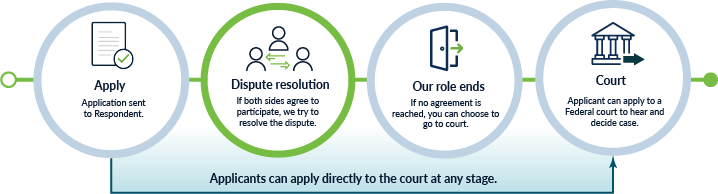
Our usual process is:
The employee applies. The application is sent to the respondent. The respondent has 7 days to respond.
If both sides agree to participate, we will work with you to resolve the dispute. In dispute resolution, you can agree to a range of outcomes, for example:
If an agreement is reached it is recorded in writing and signed by both sides. The case is then closed.
If no agreement is reached, you can choose to go to court.
You can apply to the Federal Court or the Fair Work division of the Federal Circuit Court to decide the case.
General protections application not involving dismissal (Form F8C) – use this form if you have:
IMPORTANT: You are not required to attempt dispute resolution in cases that do not involve dismissal.
You can apply directly to the Federal Court or the Fair Work division of the Federal Circuit and Family Court at any stage.
Response to general protections application not involving dismissal (Form F8D) – use this form if you have been asked to respond to a general protections application NOT involving dismissal.