Introduction
If you’re thinking about making a general protections dismissal application, please read the information below and check if you can apply.

If you’re thinking about making a general protections dismissal application, please read the information below and check if you can apply.
Our role in general protections cases is limited to dispute resolution.
We can help you talk to the other side to see if you can agree on a way to resolve your case. We do not investigate your case or decide who is right or wrong.
If your case is not resolved, the next step is to take your case to a federal court so they can decide whether or not the law has been broken.
To apply you must:
You must apply within 21 days of the dismissal taking effect.
Lee is employed by Cleaning Services Pty Ltd but is away from work on sick leave. He has a medical certificate.
The day before he was expected to return to work, Lee contacts his employer to tell them he is still unwell and will need to take further sick leave. His employer says 'Don’t bother coming back to work. I need someone I can rely on. I’ll pay out your notice.'
Lee may be able to apply for general protections involving dismissal because:
Lee must apply within 21 days of the dismissal.
In an unfair dismissal case, the focus is on whether your dismissal was harsh, unjust or unreasonable. In a general protections case, you are saying that you were fired for a reason that is against the law.
This is a strict time limit under the law and late applications are generally not accepted. You can request an extension of time in exceptional circumstances; however, most (about 80%) are denied.
For example, if you have already made an unfair dismissal application or an application under anti-discrimination laws about your dismissal.
Be clear who you are starting legal action against (the respondent). You need to provide the respondent’s name, contact details and Australian Business Number (ABN) if it’s a business.
Be aware that your case may end up in court.
To find out how much the application fee is, go to our Fees and costs webpage. You can ask to have the fee waived if it would cause you serious financial hardship.
Watch our short video on 5 things to know before you apply in general protections dismissal cases.
This video can help you decide if this is the right type of application for you.
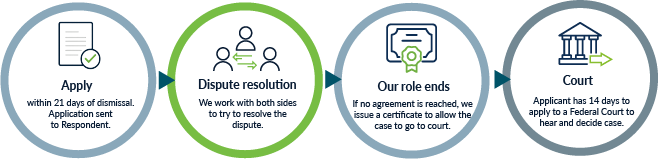
Our usual process is:
The employee applies within 21 days of the dismissal taking effect. The application is sent to the respondents. They have 7 days to respond.
We work with both sides to try to resolve the dispute. In dispute resolution both sides can agree to a range of outcomes, for example:
If an agreement is reached it is recorded in writing and signed by both sides. The case is then closed.
If no agreement is reached, we issue a certificate to allow the case to go to court. If the Commission Member thinks you are unlikely to win at court, the certificate we issue must say this.
You will have 14 days after the certificate is issued to either:
Arbitration in these cases is rare. All parties must agree to arbitration in the Fair Work Commission and all must sign the Form F8B before you send it to us.
Answer some simple questions to see if you can make a general protections dismissal application. If you can, you’ll be directed to the application form.
Response to general protections application involving dismissal – use this form if you are a respondent, or their representative, and have been asked to respond to a general protections dismissal application.